









Introduction
Have you ever reached the end of the day and wondered where all your time went?
Maybe you had a long list of things to do.
But somehow, many of those tasks are still waiting for you.
This happens to almost everyone.
You may spend time:
* Answering emails
* Writing reports
* Creating social media posts
* Planning your day
* Looking for important files
* Taking notes during meetings
* Organising your work
These jobs are important.
But they can also take a lot of time.
The good news is that you do not have to do everything by yourself.
Today, AI productivity tools can help you finish many everyday tasks more quickly.
They can help you stay organised.
They can help you plan your work.
They can even help you think of new ideas.
But remember one important thing.
AI is not here to replace you.
It is here to help you do your work more easily.
Think of AI as a smart assistant that helps you stay focused while you make the important decisions.
In this guide, I will explain everything in simple English.
By the end of this article, you will understand:
* What AI productivity tools are
* Why people use them
* Their biggest benefits
* How they work
* How to choose the right tool
* Common mistakes to avoid
* The best AI productivity tools for beginners
Let’s get started.
What Are AI Productivity Tools?
AI productivity tools are software programs that use artificial intelligence to help you complete tasks faster and more efficiently.
Let’s make that even simpler.
Imagine you have ten things to do today.
You need to:
* Reply to emails
* Write a blog post
* Attend a meeting
* Plan tomorrow’s work
* Create social media content
* Organise your notes
Doing all of this alone can feel stressful.
Now imagine you have a helpful assistant.
The assistant reminds you about important tasks.
It helps you write.
It organises your notes.
It suggests better ideas.
It saves you time.
That is exactly what AI productivity tools do.
They help you work smarter.
You still make the important decisions.
The AI simply helps you finish your work more quickly.
What Does Productivity Mean?
Before we continue, let’s understand one important word.
Productivity means getting important work done in the best way possible.
Being productive does not mean staying busy all day.
It means using your time wisely.
For example:
Instead of spending three hours writing emails, you finish them in one hour.
You now have two extra hours to work on something more important.
That is productivity.
The goal is not to work harder.
The goal is to work smarter.
Why Do People Use AI Productivity Tools?
More people are using AI productivity tools every day.
Students use them.
Business owners use them.
Bloggers use them.
Freelancers use them.
Even large companies use them.
Why?
Because they make everyday work easier.
Let’s look at the biggest reasons.
1. They Save Time
Time is valuable.
Once it is gone, you cannot get it back.
AI helps you save time by completing repetitive tasks more quickly.
For example, it can help you:
* Write first drafts
* Summarise long documents
* Organise notes
* Plan meetings
* Create task lists
This gives you more time to focus on important work.
2. They Help You Stay Organised
Many people lose time because they cannot find what they need.
Important notes may be in one place.
Documents may be somewhere else.
Emails may be buried in a crowded inbox.
AI productivity tools help organise your work so everything is easier to find.
3. They Help You Focus
Sometimes distractions make it difficult to finish your work.
AI tools can help you:
* Create daily plans
* Set reminders
* Prioritise important tasks
* Keep track of deadlines
This helps you stay focused on what matters most.
4. They Help You Write Faster
Writing can take a long time.
AI can help you create:
* Email drafts
* Blog outlines
* Reports
* Meeting notes
* Social media captions
Remember to review and improve everything before using it.
5. They Help You Learn Faster
Some AI tools explain difficult topics in simple language.
They can answer questions and summarise information.
This makes learning easier, especially for beginners.
Benefits of AI Productivity Tools
Now let’s look at the biggest benefits.
You Finish More Work
Many people feel busy all day but finish very little.
AI helps reduce repetitive work.
This allows you to complete more important tasks.
You Reduce Stress
When your work is organised, you feel more in control.
You spend less time worrying about forgotten tasks.
You Improve Your Writing
Many AI tools help improve:
* Grammar
* Spelling
* Sentence structure
* Clarity
This makes your writing easier for others to understand.
You Stay Better Organised
AI tools can organise:
* Notes
* Files
* Projects
* To-do lists
* Calendars
Everything becomes easier to manage.
You Have More Time for Important Work
Instead of spending hours on repetitive jobs, you can focus on:
* Learning new skills
* Helping customers
* Growing your business
* Spending time with your family
This is one of the biggest advantages of AI productivity tools.
Who Can Use AI Productivity Tools?
Almost anyone can benefit from these tools.
For example:
Bloggers
Plan articles.
Write outlines.
Organise content calendars.
Students
Take notes.
Summarise lessons.
Plan study schedules.
Freelancers
Manage projects.
Reply to clients.
Organise daily work.
Small Business Owners
Plan marketing.
Manage customers.
Write emails.
Track tasks.
Office Workers
Take meeting notes.
Create reports.
Organise schedules.
Manage projects.
Content Creators
Plan videos.
Write scripts.
Organise ideas.
Schedule content.
How AI Productivity Tools Work
The process is much simpler than many people think.
Let’s go through it together.
Step 1: You Tell the AI What You Need
Everything starts with your instructions.
For example:
* Organise my notes.
* Create a meeting summary.
* Write an email.
* Plan my week.
* Make a task list.
The clearer your instructions are, the better the results.
Step 2: The AI Analyses Your Request
The software studies your request.
It looks at the information you provide.
Then it creates useful suggestions.
This usually happens in just a few seconds.
Step 3: The AI Gives You Results
Depending on your request, the AI may create:
* A summary
* A schedule
* A task list
* A report
* An email
* A draft article
These results help you save time.
Step 4: You Review Everything
Never assume the AI is always correct.
Always read through the results.
Check:
* Grammar
* Facts
* Dates
* Names
* Missing information
A quick review helps you avoid mistakes.
Step 5: Add Your Own Ideas
This is where your personal experience becomes important.
Add:
* Your own thoughts
* Helpful examples
* Personal advice
* Real experiences
These small additions make your work much more valuable.
Why Human Skills Still Matter
AI is a wonderful tool.
But it cannot replace qualities like:
* Kindness
* Creativity
* Honesty
* Good judgement
* Personal experience
These are things only people can truly provide.
AI helps you work faster.
You make the important decisions.
That combination often produces the best results.
Your First Goal
If you are new to AI productivity tools, do not try to learn everything at once.
Start with one simple task.
For example:
* Organise your daily to-do list.
* Write one email.
* Plan one week’s work.
* Summarise one document.
Learn one tool well.
Then move on to the next.
Small improvements every day can lead to big results over time.
How to Choose the Best AI Productivity Tool
Now that you know what AI productivity tools are, you may be wondering:
“Which AI productivity tool should I choose?”
There are hundreds of AI tools on the internet.
Some help you write.
Some help you organise your work.
Some help you plan your day.
Others help you manage projects or take notes.
The truth is simple.
You do not need every AI tool.
You only need the ones that help you solve your biggest problems.
Let’s look at how you can choose the right one.
1. Know What You Need Help With
Before you download any AI tool, ask yourself one simple question:
“What task takes up most of my time?”
Maybe you spend hours:
* Writing emails
* Planning your day
* Organising files
* Creating blog posts
* Taking meeting notes
* Managing projects
* Replying to customers
Once you know your biggest challenge, it becomes much easier to choose the right AI tool.
2. Choose a Tool That Is Easy to Use
If you are a beginner, look for software that is simple.
A good AI productivity tool should have:
* A clean dashboard
* Easy-to-read menus
* Helpful guides
* Video tutorials
* Good customer support
Simple tools help you learn faster.
You will spend less time trying to understand the software and more time getting your work done.
3. Start With Free Plans
You do not have to spend a lot of money.
Many AI productivity tools offer:
* Free plans
* Free trials
* Affordable monthly subscriptions
Start with the free version.
As your work grows, you can decide if you need more advanced features.
4. Pick a Tool That Fits Your Work
Not every AI tool is made for the same purpose.
For example:
If you are a blogger, you may need:
* Writing tools
* SEO tools
* Content planning tools
If you own a business, you may need:
* Project management tools
* Customer support tools
* Email assistants
If you are a student, you may need:
* Note-taking tools
* Study planners
* Research assistants
Choose software that matches your daily work.
5. Read Reviews Before Choosing
Before paying for any software, read reviews from real users.
Find out what people say about:
* Ease of use
* Features
* Speed
* Customer support
* Reliability
* Value for money
Reviews can help you make a better decision.
Step-by-Step Guide to Using AI Productivity Tools
You do not have to change your whole routine in one day.
Take one small step at a time.
Step 1: Choose One Task
Start with one task that takes too much of your time.
For example:
* Writing emails
* Planning your day
* Organising notes
* Managing projects
* Creating content
Learning one task first makes everything easier.
Step 2: Choose the Right AI Tool
Now choose a tool that helps with that task.
For example:
* A writing assistant
* A note-taking app
* A project management tool
* A meeting assistant
* A scheduling tool
One good tool is usually enough to get started.
Step 3: Learn the Basics
Spend some time learning how the software works.
Read the help guide.
Watch tutorial videos.
Practise using simple features first.
The more you practise, the easier it becomes.
Step 4: Let AI Help You
Use the AI to create the first version of your work.
For example, ask it to:
* Write an email draft
* Create a to-do list
* Summarise a meeting
* Organise your notes
* Plan your week
This saves you valuable time.
Step 5: Review the Results
AI is helpful, but it is not perfect.
Always check:
* Grammar
* Facts
* Dates
* Names
* Missing information
A few minutes of checking can prevent mistakes.
Step 6: Add Your Personal Touch
This is one of the most important steps.
Only you know:
* Your work style
* Your goals
* Your customers
* Your experiences
Add your own ideas and make the final result your own.
Step 7: Keep Improving
After using AI for a while, ask yourself:
* Did it save me time?
* Did it make my work easier?
* What worked well?
* What can I improve?
Learning from your experience helps you become more productive.
Practical Examples
Let’s look at a few simple examples.
Example 1: A Blogger
A blogger wants to publish one article every week.
The AI helps by:
* Suggesting topics
* Creating outlines
* Writing first drafts
* Organising a content calendar
The blogger reviews everything and adds personal experience before publishing.
Example 2: A Student
A student has many subjects to study.
The AI helps:
* Summarise lessons
* Create study plans
* Organise notes
* Explain difficult topics
This makes studying easier and saves time.
Example 3: A Small Business Owner
A business owner uses AI to:
* Reply to emails
* Plan meetings
* Create social media posts
* Organise customer information
This leaves more time to focus on customers and growing the business.
Example 4: A Freelancer
A freelance writer uses AI to:
* Organise projects
* Create task lists
* Draft client emails
* Plan weekly work
This helps the freelancer stay organised and meet deadlines.
Helpful Tips
These simple tips will help you get better results.
Start Small
Do not try to learn five AI tools at once.
Choose one.
Learn it well.
Then move on to another.
Keep Your Work Organised
Store your:
* Notes
* Files
* Documents
* Projects
* Calendars
in one place whenever possible.
Being organised helps you work faster.
Keep Learning
AI tools improve regularly.
Spend a little time learning new features.
Even small improvements can make your work easier.
Protect Your Information
Use trusted AI tools.
Keep your passwords safe.
Protect your personal and business information.
Good security is always important.
Focus on Helping People
If you use AI for work or business, always ask yourself:
“Will this help the person reading or using my work?”
Helping people should always come first.
Common Mistakes to Avoid
Many beginners make these mistakes.
You do not have to.
Using Too Many AI Tools
Some people install many AI apps at once.
This often causes confusion.
Start with one tool.
Master it.
Then add another if needed.
Trusting AI Without Checking It
AI can sometimes make mistakes.
Always review its work before sharing or publishing it.
Forgetting Your Own Ideas
AI can give you suggestions.
But your own knowledge and experience make your work unique.
Do not be afraid to add your own voice.
Ignoring Your Goals
Do not use AI just because it is popular.
Use it because it helps you reach your goals.
Choose tools that solve real problems.
Giving Up Too Soon
Learning something new takes time.
You may feel confused at first.
That is normal.
Keep practising.
The more you use AI, the easier it becomes.
Best AI Productivity Tools for Beginners
You have learned what AI productivity tools are and how they can help you.
Now let’s look at some of the best AI productivity tools for beginners.
These tools are easy to use and can help you save time, stay organised, and get more work done.
Remember, you do not need every tool on this list.
Start with one or two that solve your biggest problem.
As your skills grow, you can always try more tools.
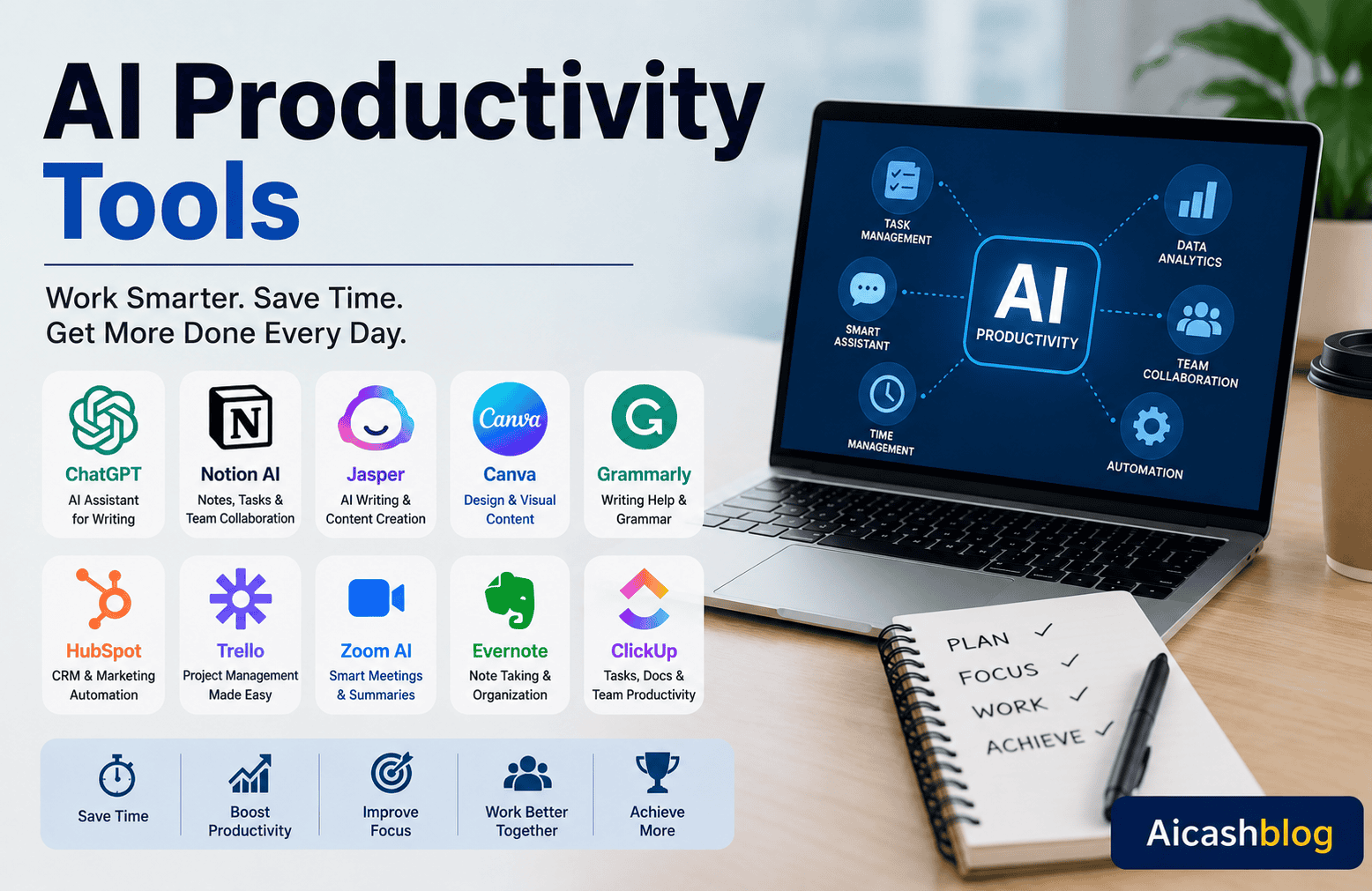
1. ChatGPT – Best for Writing and Everyday Tasks
ChatGPT is one of the most popular AI productivity tools.
It can help you:
* Write emails
* Create blog posts
* Summarise information
* Brainstorm ideas
* Plan projects
* Make to-do lists
* Answer questions
It is like having a helpful assistant that is ready to help you at any time.
Best for:
* Bloggers
* Students
* Freelancers
* Small business owners
* Content creators
2. Notion AI – Best for Organising Work
Notion AI helps you keep everything in one place.
You can use it to organise:
* Notes
* Projects
* Daily tasks
* Meeting notes
* Business plans
* Content calendars
If you often forget where you saved important information, Notion AI can help you stay organised.
3. Grammarly – Best for Better Writing
Good writing helps people understand your message.
Grammarly checks your writing for:
* Grammar mistakes
* Spelling errors
* Punctuation
* Sentence clarity
It also suggests simple improvements to make your writing easier to read.
4. Canva – Best for Creating Designs
Canva is one of the easiest design tools available.
You can create:
* Social media posts
* Blog images
* Presentations
* Flyers
* Posters
* YouTube thumbnails
You do not need design experience.
Canva provides ready-made templates that are easy to customise.
5. Google Gemini – Best for Research and Ideas
Google Gemini can help you:
* Find information
* Explain difficult topics
* Brainstorm ideas
* Summarise documents
* Help with planning
It is useful when you want to learn something new or start a project.
6. Microsoft Copilot – Best for Office Work
If you often use Microsoft Office, Copilot can help you work more efficiently.
It can assist with:
* Writing documents
* Creating presentations
* Summarising meetings
* Working with spreadsheets
* Managing emails
It is especially useful for office workers and business professionals.
7. Trello – Best for Managing Projects
Trello helps you organise your work using simple boards and task lists.
You can:
* Plan projects
* Track progress
* Set deadlines
* Work with a team
* Organise daily tasks
It is simple enough for beginners and powerful enough for growing businesses.
Which AI Productivity Tool Should You Start With?
If you are just getting started, you do not need complicated software.
A simple toolkit could include:
* ChatGPT for writing, planning, and ideas.
* Notion AI for organising your work.
* Grammarly for improving your writing.
* Canva for creating graphics.
* Trello for managing tasks and projects.
This combination is enough for many bloggers, freelancers, students, and small business owners.
As your work grows, you can explore more advanced AI tools.
Frequently Asked Questions (FAQ)
What are AI productivity tools?
AI productivity tools are software programs that use artificial intelligence to help you complete tasks more quickly, stay organised, and improve your daily work.
Are AI productivity tools free?
Many AI productivity tools offer free plans.
Some also provide paid plans with extra features.
You can often start with a free version and upgrade later if needed.
Can beginners use AI productivity tools?
Yes.
Most modern AI tools are designed to be easy to learn.
If you can use a computer or smartphone, you can learn these tools with a little practice.
Will AI make me more productive?
AI can help you save time and reduce repetitive work.
However, you still need good planning, discipline, and clear goals.
AI works best when you use it as a helpful assistant.
Can AI replace human workers?
No.
AI can help with routine tasks, but it cannot replace human creativity, kindness, experience, or good judgement.
People are still needed to make important decisions.
Key Points to Remember
Before you leave, let’s review the main ideas from this guide.
* AI productivity tools help you work faster and smarter.
* Start with one or two tools instead of trying many at once.
* Choose tools that solve your biggest problems.
* Always review AI-generated work before using it.
* Keep learning as new features and tools become available.
* Use AI to support your work, not replace your own thinking.
Remember this simple idea:
AI can help you save time, but your knowledge, creativity, and willingness to help others are what make your work truly valuable.
Conclusion
AI productivity tools are changing the way people work.
They help you organise your tasks, write faster, manage projects, and make better use of your time.
Whether you are a student, blogger, freelancer, or business owner, AI can help you become more productive.
But remember, the goal is not to let AI do everything.
The goal is to use AI wisely while continuing to think, learn, and make good decisions.
The more you practise, the more confident you will become.
Over time, those small improvements can make a big difference in your work and your life.
Your Next Step
You do not need to learn every AI tool today.
Start with one simple task that takes too much of your time.
Then choose one AI productivity tool that can help you with that task.
Use it for a few days.
Learn how it works.
Once you feel comfortable, move on to another task.
Small, steady progress is often the fastest way to build lasting skills.
Call to Action
Thank you for reading this guide on AI Productivity Tools.
I hope you now understand how AI can help you save time, stay organised, and get more important work done every day.
If you found this guide helpful, save it so you can come back to it whenever you need a reminder.
You can also share it with a friend, family member, or colleague who wants to work smarter and become more productive.